Quiet Quitting: What It Really Means, Why It Happens, and What To Do Instead

Quiet quitting is all around us, but sometimes hard to spot. According to Gallup, 62% of global employees report feeling “not engaged”. Photo by Alex Kotliarskyi on Unsplash.
Reading time: 9 minutes
Quick answer:
Quiet quitting means doing exactly what your job description requires—nothing more, nothing beyond it. It's not about leaving your job, but about withdrawing discretionary effort: no volunteering for extra projects, no performing enthusiasm you don't feel. According to Gallup's 2025 data, 62% of global workers fall into this category. It often stems from poor management, lack of recognition, or a breakdown of trust between employer and employee. While it can provide short-term relief, it rarely resolves the underlying problem—and for most people, it quietly erodes purpose, confidence, and pride over time.
What you'll get from this article:
✔ A clear definition of quiet quitting and what it actually looks like in practice
✔ The real causes behind disengagement—from management failure to macroeconomic factors
✔ The hidden personal costs quiet quitting carries over time
✔ When quiet quitting makes sense for people pursuing Financial Independence
✔ Smarter alternatives: how to re-engage, redesign, or exit intentionally
TL;DR — Quiet Quitting at a Glance
💼 62% of workers globally are not engaged (Gallup 2025)
🚫 Quiet quitting = doing your job, but nothing beyond it
⚙️ Main causes: poor management, lack of recognition, low trust, rigid job markets
🧠 Feels better than burnout—but hurts pride and growth long term
💡 Works short-term for Financial Independence seekers who coast mindfully toward retirement
🎯 Better alternative: re-engage or exit intentionally
Understanding Quiet Quitting in a Changing Workplace
In 2022, a word spread across TikTok and into every workplace conversation: quiet quitting. It's a phenomenon we explore in depth in our guide to work, purpose, and Financial Independence. It named something millions of workers already recognised in themselves—the moment you stop going above and beyond, and start doing exactly what your contract says. Nothing more.
Quiet quitters complete their assigned tasks, attend meetings, and meet deadlines, but they're for all other purposes disengaged from the workplace. Don't expect them to volunteer ideas, take on extra projects, or feign excitement about the next corporate retreat.
It's not about resigning, but withdrawing the discretionary effort that most employers structurally depend on—the staying late, the raised hands, the performed enthusiasm. According to Gallup's 2025 data, 62% of global workers are already in the quiet quitting mindset.
The reasons are understandable. After repeated rounds of layoffs and restructurings, many workers have concluded that their loyalty simply isn't reciprocated by their employers. Cyclical redundancies—especially in the US—make it clear that the employer-employee relationship is purely transactional. The frustration deepens when employers respond by doubling down on "we're one big family" type culture.
In that climate, pulling back feels rational. But while quiet quitting can feel like a fair response to a rough system, it's rarely a fulfilling long-term strategy—for the employee or the employer. This article unpacks why, and what smarter alternatives look like.

Quiet quitters do exactly what’s in their job description—nothing less, but also nothing more. Photo by Vitaly Gariev on Unsplash.
What Is Quiet Quitting and Why Is It on the Rise?
Quiet quitting means performing your role competently, but without discretionary effort. In other words, it’s quitting your job’s extras—not your job itself. You meet basic expectations, enough to not get fired, but you simply don’t stretch your effort beyond them—you stay strictly within the scope of your contract or job description.
It would be easy to label this as rebellion or laziness, but it often comes from a rational adjustment after years of intermittent burnout, unmet promises, or outright toxic working cultures.
The pandemic forced millions to reassess their relationship to work, and for many, pulling back their engagement became a form of quiet resistance. You can see this especially among Gen Z, who report higher sensitivity to burnout and lower tolerance for workplaces that lack purpose.
Gallup’s State of the Global Workplace 2025 report shows that 62% of global workers are “not engaged” in their current role—meaning they’re psychologically detached and not aligned with their organizations’ goals. They’re putting in time, but not energy and passion. They’re watching the clock and counting the minutes until the day ends.
Another 17% of global workers are “actively disengaged.” These are typically frustrated or resentful employees who would likely take the opportunity to do harm to their organization in subtle ways. Gallup defines them as employees who work against the aims of the organization. Some experts even describe this as a step beyond quiet quitting—“loud quitting” or active disengagement.
Incredibly, only 21% of global workers actually feel engaged in their job and aligned with their current organization.
In this article, we’ll use the “not engaged” and “actively disengaged” segments as a proxy for quiet quitters. As observed in Figure 1, after many years of steady growth, global engagement reached its peak of 22% in 2019 and has remained fairly flat ever since. In 2024, 79% of global employees reported not feeling engaged in their workplace.
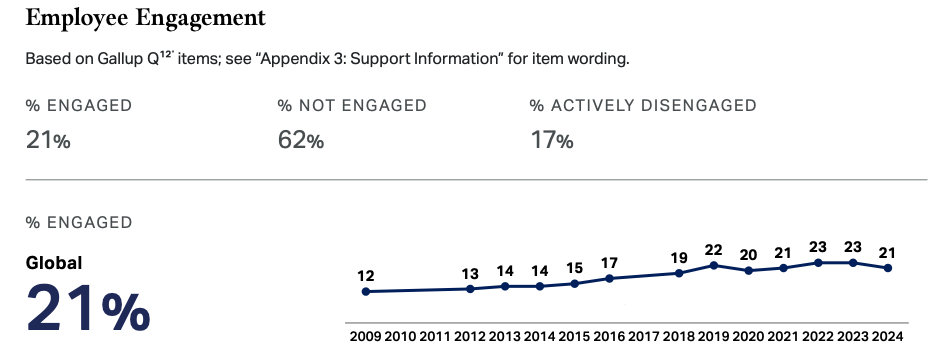
Figure 1. Global employee engagement over time. After steady increases in earlier years, engagement in the workspace has stalled since 2019. There is a clear slump in engagement during the pandemic in 2020. Source: Gallup (2025)
The appeal for quiet quitting stems from a growing distrust between employees and the organizations they work for. After repeated rounds of layoffs, budget cuts, and restructurings, it has become clear to workers in many industries that their loyalty is not reciprocated—their relationship is simply transactional and often determined by broader market forces. The company usually won’t blink when it’s time for layoffs, when market conditions push them in that direction.
Employees pulling back is, in my view, a rational response. Unless you have genuine ambition or a clear path forward, why pour discretionary effort into an organisation that won't hesitate to let you go when the numbers demand it?
If companies preach the “we’re one big family” corporate culture, but dismiss employers overnight in the name of optimization, then employees, understandably, will stop playing along. Employers that engage in rounds of layoffs need to acknowledge this increasing erosion of trust.
At the same time, the rise of quiet quitters also reflects a cultural shift in priorities. Workers from younger generations increasingly value work-life balance and mental health over the grind and constant career advancement of previous generations. In this context, quiet quitting is seen as a way to regain personal boundaries in systems that don’t care for them when the going gets tough.
I don’t think younger generations are lazy. They simply have taken a saner perspective of the role of their career and job in their life, and are more realistic of the risks in going down the grinding and corporate ladder culture at the expense of other important dimensions in life.

Gen Z are not lazy—they have a more nuanced understanding of their jobs and the place it should have within their lives. Photo by Annie Spratt on Unsplash.
Why Employees Quiet Quit—and the Root Causes Behind It
There’s no single reason why people disengage, but Gallup research consistently points to a handful of structural causes. First, the lack of recognition and growth opportunities is one of the top drivers. Many quiet quitters have already tried going above-and-beyond and have a taste of how that turned out for them in the past. If employees feel invisible or believe their contributions go unnoticed, it’s only natural for their motivation to weaken.
Many organisations rely on performance review systems that tie pay to subjective evaluations once or twice a year. In theory, this should be straightforward—but in practice, the annual review cycle can create a disconnect between day-to-day feedback and what gets said when salary is on the table. It's not always intentional, but workers who feel the goalposts shift at review time will eventually stop extending the benefit of the doubt.
Other workers face “career ceilings” with no clear path forward. Over time, they stop trying to excel because they no longer see a meaningful link between effort and reward.
Another important factor is management quality. The Gallup report highlighted that 70% of team engagement is directly attributable to the manager. Indeed, a great manager can make almost any job feel fulfilling; while a poor one can make even good and meaningful work unbearable.
I’m sure many people can relate to having drastically different experiences in the same company under different managers. The difference, of course, isn’t the work—but the leadership. When managers fail to communicate purpose, provide consistent feedback, or care about well-being, employees naturally tend to withdraw.
Finally, macroeconomic factors also shape engagement. In regions with rigid job markets—like many parts of Europe—engagement levels are among the lowest globally (just 13% of employees engaged, Figure 2). Changing jobs can be incredibly slow, bureaucratic, and stressful. I’m sure this is another factor why some employees prefer to quiet quit rather than face an uncertain ordeal.
In contrast, in more fluid job markets like the US or Canada, employees are actually allowed to exit toxic situations more easily. It’s not surprising then that the number of quiet quitters globally is lowest in the US and Canada (52% of disengaged; 17% actively disengaged; 31% of engaged workers), despite having more of a grinding culture. The ability to leave easily may act as a release valve against widespread quiet quitting. Of course, there is no free lunch here—in these fluid job markets there is also less job protection and it’s easier to get fired.
Not all disengagement stems from bad employers—some roles are simply mismatched to personal values or interests. Recognizing that distinction is key before assigning blame entirely to the employer.
But even when quiet quitting feels justified, it comes with its own set of hidden costs—both emotional and professional.
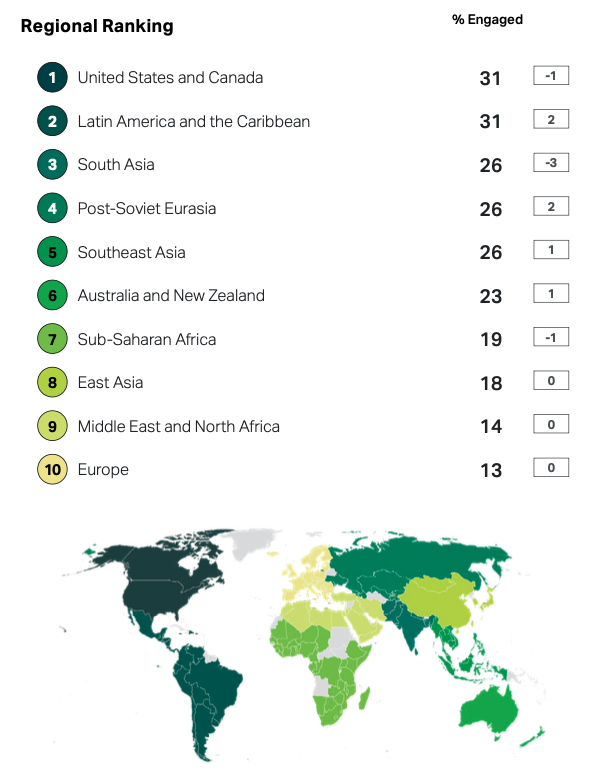
Figure 2. Global employee engagement in 2024 across regions. As observed, the regional engagement is highest in North America and lowest in Europe. Source: Gallup (2025)
The Hidden Costs: Why Quiet Quitting Rarely Feels Good Long Term
Unfortunately, quiet quitting has its costs. And we’re not only talking about the estimated $438 billion in lost productivity from lack of engagement in the workplace, but also at the personal level.
Although often it may begin as a form of self-preservation—an emotional defense against frustration or burnout—over time it tends to erode one’s sense of purpose and pride. Doing the bare minimum may indeed bring you temporary relief, but for people who take pride in doing good work, it may feel hollow quickly.
You may be protecting your time, but at the same time you also risk dulling your curiosity, creativity, and confidence. Losing that part of yourself can be tricky, even if your employer doesn’t value your best work or they really did wrong you.
There is also an emotional cost. If quiet quitting comes from a place of resentment, this feeling can increase over time. While the resentment itself can feel fully justified, it’s rarely good to carry around these emotions with you. Work occupies such a large share of our day that disengagement eventually can spill into our overall well-being. Try quiet quitting while staying upbeat with a sense of fulfillment—over the long run, this will be a difficult task.
Gallup’s data shows that engaged employees are more likely to describe themselves as “thriving” across life domains, while quiet quitters often report more stress and anxiety. And while most quiet quitters don’t get fired outright, the real cost often shows up in slower career growth, fewer opportunities, and a gradual loss of visibility within the organization and sector.
The danger I’m more concerned about here—beyond professional stagnation—is personal stagnation. Psychologically, it often signals a deeper loss of motivation and sense of belonging—key factors behind job satisfaction and long-term performance. Quiet quitting understandably feels like a relief compared to burnout, but it’s still not an ideal long-term state anyone should wish to be in for years.
I’ve experienced this personally. While quiet quitting can feel like the right response at the time and even if your employer really deserved it, in the long-term it’s unlikely to get you out of the tough situation you find yourself in—it’s simply not an effective response.
In parallel to quiet quitting, you’ll need to find another way out of the mess. Unfortunately, this ties in to what we mentioned above on job market fluidity; in countries and sectors where it can take up to a year (or more) to change companies, quiet quitting sometimes feels like the least bad option available. But quiet quitting is ultimately a reactive response. What we should really aim for is to become more resilient and antifragile to career shocks and uncertainty.
This is exactly why we focus on pursuing Financial Independence on this site: not just as a get-rich goal, but as insurance against precisely this recurring situation. The more your investments cover your expenses, the less any single job, manager, or layoff can dictate your life. Even being partway there changes everything.
👉 See how Financial Independence works as a career hedge.
Another perspective is to reflect on what we’ll look back on towards the end of our lives. The Top Five Regrets of the Dying famously reports overworking as one of the top regrets of the dying, so we should certainly be mindful of that. Grinding away our lives is not the way to go for most of us.
But we should also not forget another common regret of the dying—wishing one had lived more true to themselves, taken more risks, and spend time on meaningful pursuits. For many—including, I think, myself—that could include wishing they had left that unfulfilling or problematic job sooner. Many may regret not changing jobs or starting their own business earlier.
While quiet quitting can be a solid protective step in some cases and can buy you some breathing room in a rough situation, don’t let it become the long-term story of your working life. There are other options out there—whatever it is we do, let’s aspire to join the 21% of globally engaged workers.
That said, there are circumstances where quiet quitting is the least bad option available—and for a specific group of readers, it can even be strategic.

You can really tell when someone is truly engaged in their work. If you’re unhappy and quiet quitting at work, it’s worth to reflect on what type of work would make you thrive on a day-to-day basis. Photo by Austin Distel on Unsplash.
When Quiet Quitting Works (and When It Backfires)
There may be some exceptions where quiet quitting makes sense. For those close to reaching Financial Independence (FI)—especially in well-paying corporate roles—quiet quitting (sometimes referred to as coasting) can serve as a short-term bridge to reaching financial freedom.
If you’re perhaps within a year or two of FI, working remotely, and perhaps able to maintain balance and professionalism while protecting your energy, then quiet quitting may be a reasonable approach. If you’re not sure how close you are to Financial Independence, you can use our free FI Calculator (email unlock) to project how soon you could reach early retirement.
The key difference, I think, is the mindset—that you’re operating from a place of calm detachment, not resentment. You’ve made peace with your role and are using it strategically to reach your next phase. In any case, quiet quitting is a temporary, not permanent measure.
However, for most people, quiet quitting done from a place of anger or resentment can become a trap. When your motivation drops, your performance follows, which could limit future opportunities presenting themselves, and, ironically, end up prolonging this phase of dissatisfaction. If you enjoy contributing value and hold yourself to a high standard, then quiet quitting will feel unnatural—and over time, could quietly undermine your confidence and self-image.
That’s why for most FI seekers, I think it’s smarter to either redesign your work situation or exit entirely. Even part-time work, freelancing, or a lower paying field that energizes you can bring back the sense of progress and fulfillment that quiet quitting dulls. We simply spend too many hours a day working for it to not provide some sense of engagement.
Of course, employers share a lot of responsibility here. If they expect engagement, they also need to create the conditions that foster it. That means not pushing people into roles that don’t suit them, fair pay, and flexible working options—the right to which is itself now politically contested in some countries. In Germany, proposals to restrict part-time work entitlements have framed employee flexibility as a problem to be solved rather than a right to be protected.
Employees won’t keep giving extra energy indefinitely out of goodwill—especially when they’ve seen colleagues discarded without much hesitation. Quiet quitting, in a sense, is a mirror for the leadership to hold. If quiet quitting is thriving, employers are certainly doing something wrong.
Eventually, though, every quiet quitter faces a choice: try to re-engage—or move on.

What is holding you back from the type of work that would make the time fly? For some, it could be engaging in entrepreneurship and taking control of their own schedule. Photo by Jodie Cook on Unsplash.
Quiet Quitting vs Re-Engagement: How to Fix the Job—or Leave It Well
The healthier alternative to quiet quitting isn’t “working harder”, but working differently. If you find yourself disengaged in your workplace over a substantial period of time, the first step is to diagnose why. Is it the workload, the manager, the lack of growth, or a deeper mismatch between your values and those of the organization?
Sometimes, small changes—like changing projects, negotiating more flexibility, or working with a different manager—can bring you out of quiet quitting and restore your motivation. Have an honest conversation with yourself and your employer about what would make work feel more meaningful and engaging again.
But if these efforts fail or the issue is related to a deeper misalignment, consider if it’s time to plan an exit rather than stay stuck in resignation. The process doesn’t have to be impulsive; use the quiet quitting period to strategically clarify what you want next and take steps to make that happen.
In my case, the answer to these questions was acknowledging that my ideal day included writing and thinking, research, and creative work. These elements had been previously present earlier in my career, but were slowly replaced by the tasks expected from more senior roles—managing multiple projects and people, and spending the day in meetings.
When it became clear that it would not be possible to go back to my desired role in the organization, I understood it was time to go and try something else.
The FI mindset is powerful here—it gives you the safety net and confidence to make values-aligned choices instead of clinging to security out of fear. Leaving a job thoughtfully is far better than staying half-engaged indefinitely.
For employers, the solution is pretty clear: invest in better management. As mentioned, Gallup estimates that 70% of the variance in team engagement comes down to the manager. That means leadership matters more than mission statements or HR slogans. The best organizations don’t simply demand engagement—they design for it to emerge by hiring and training managers who communicate clearly, recognize contributions, and make people feel that their work matters.
For individuals, the lesson is similar: take ownership of your engagement, but don’t confuse it with blind loyalty. If you’ve tried to re-engage and nothing changes, it may be time to exit rather than to coast indefinitely. Life is simply too short to quietly count the years until retirement in frustration.
Whether that means changing companies, shifting careers, going part-time, or pursuing FI through your own project, the goal should always be engagement and alignment—between what you do and what you value. In this context, Financial Independence isn’t just about quitting work, but about gaining the autonomy to choose how you spend your limited time and energy.
For many FI seekers, this tension shows up most acutely during the so-called “boring middle” of FI—the long stretch of the journey where the early wins and excitement are gone but the FI number is still very far away. Quiet quitting is one sub-optimal way to survive that stretch. Redesigning the work itself, as I eventually did, is usually the better approach. Quiet quitting may protect you now, but intentional change will free you later.
💬 If you’re on the path to Financial Independence, are you quietly quitting—or quietlyredesigning? What step could you take now to move from burnout to balance without losing your sense of purpose? Please share with us in the comments below.
If you enjoyed this article, here are some next steps:
👉 Trapped in a job you can't easily leave? That’s the case for pursuing Financial Independence
👉 Want the full investing framework for FIRE? See our complete investing guide
👉 Browse 130+ articles on FI, investing, work, and health at The Good Life Journey
👉 Subscribe to get free FI tools and the weekly newsletter (one-click unsubscribe anytime)
🌿 Thanks for reading The Good Life Journey. I share weekly insights on personal finance, financial independence (FIRE), and long-term investing—with work, health, and philosophy explored through the FI lens.
Disclaimers: I’m not a financial adviser, and this is not financial advice.
Check out other recent articles





























About the author:
Written by David, a former academic scientist with a PhD and over a decade of experience in data analysis, modeling, and market-based financial systems, including work related to carbon markets. I apply a research-driven, evidence-based approach to personal finance and FIRE, focusing on long-term investing, retirement planning, and financial decision-making under uncertainty.
This site documents my own journey toward financial independence, with related topics like work, health, and philosophy explored through a financial independence lens, as they influence saving, investing, and retirement planning decisions.
Frequently Asked Questions (FAQs)
-
Quiet quitting means doing exactly what your job description requires—no more, no less. Employees still perform their duties and meet deadlines, but they stop volunteering extra effort or ideas. It’s not about being lazy; it’s about setting boundaries in workplaces where going “above and beyond” has become expected but unrewarded.
-
The term gained popularity after a 2022 TikTok video captured a growing post-pandemic frustration: people felt overworked, undervalued, and easily replaceable. Gallup’s 2025 report confirms this shift—62% of workers are “not engaged,” showing that millions are emotionally detached from their jobs. Economic uncertainty and repeated layoffs have only amplified the trend.
-
Most quiet quitting starts with unmet expectations—when hard work isn’t recognized or rewarded. Poor management, limited growth paths, and toxic workplace cultures are major triggers. Many employees experience burnout after years of overextension and realize that doing more no longer improves their situation or well-being.
-
Rarely immediately. Quiet quitting is about doing enough to meet requirements, so it’s hard to justify dismissal. However, quiet quitters often see slower promotions, reduced visibility, and fewer opportunities for career growth. Over time, the professional stagnation can be as damaging as burnout or even lead to job loss if performance gradually slips.
-
Quiet quitting is a behavioral response—doing only what’s required. Disengagement, as Gallup measures it, is psychological detachment from the organization’s goals. Quiet quitting can be seen as the visible form of disengagement, while “actively disengaged” employees go further, sometimes working against the organization’s interests.
-
In the short term, quiet quitting can protect your mental health and prevent burnout. But over the long term, it can lead to apathy, loss of confidence, and missed chances to grow. The healthiest path is to treat it as a temporary pause—a signal to redesign your work or plan a more meaningful career move.
-
Gen Z entered the workforce during unstable economic times and a mental health crisis. They’re less willing to sacrifice well-being for corporate loyalty. While older generations saw “hustle” as the path to success, many Gen Z workers are more skeptical and prioritize balance and flexibility—making quiet quitting both a cultural statement and a coping mechanism.
-
Gallup’s research shows 70% of engagement depends on the manager. Employers can reduce quiet quitting by training better leaders, recognizing contributions, offering flexibility, and building trust after layoffs. When employees feel respected and see how their work contributes to something meaningful, they naturally re-engage.
-
First, reflect on what’s causing the disengagement—poor management, unclear goals, or personal burnout. Discuss options for new projects or flexibility before checking out mentally. If the culture won’t change, plan your exit intentionally. A strong emergency fund or progress toward Financial Independence can give you the freedom to move on without fear.
-
For some close to Financial Independence, a calm version of quiet quitting—“quiet coasting”—can help preserve energy and mental health while finishing the last stretch. The key is mindset: doing it from peace, not resentment. But it should be temporary. Long-term disengagement risks eroding the purpose and curiosity that FI is meant to protect.
Join readers from more than 100 countries, subscribe below!
Didn't Find What You Were After? Try Searching Here For Other Topics Or Articles: